
Ingredient science
What Is Astaxanthin? The Complete Beginner’s Guide
Why salmon is pink, where astaxanthin really comes from, how it behaves as an antioxidant, and what research can and cannot yet say about it for skin.
Key takeaways
- Astaxanthin is a red-orange carotenoid pigment made by certain microalgae, yeasts and bacteria. It is not a vitamin.
- Salmon, shrimp and krill do not make it; they collect it through the food chain.
- It is an effective antioxidant in the laboratory, but laboratory results alone do not prove effects in people.
- Small trials of oral astaxanthin report modest gains in skin moisture and elasticity. Evidence for applying it to skin is far more limited.
- Source, molecular form and formulation all differ, so “astaxanthin” on a label does not tell the whole story.
Have you ever wondered why salmon is pink?
Wild salmon has pink-orange flesh, prawns turn pink when cooked, and a lobster changes from slate blue to red in the pot. One molecule sits behind all three: astaxanthin (say “asta-ZAN-thin”).
None of these animals makes it. Astaxanthin begins in microscopic organisms, above all single-celled algae, and travels up the marine food chain. A salmon is pink because of what it ate, and what its food ate before that.3
Astaxanthin has since moved from fish farming and laboratories into supplements and skincare, mainly because of its antioxidant chemistry.1 This guide explains what it is, how it behaves and what research does and does not show.
What exactly is astaxanthin?
Astaxanthin is a natural pigment from the carotenoids, the family of yellow, orange and red pigments that also colour carrots, tomatoes and egg yolks. Carotenoids share a long backbone of carbon atoms joined by alternating single and double bonds. Picture a string of beads that interacts with light: that chain gives each carotenoid its colour.
A xanthophyll, not a carotene
Carotenes, such as beta-carotene in carrots, contain only carbon and hydrogen. Xanthophylls also contain oxygen. Astaxanthin (C₄₀H₅₂O₄) is a xanthophyll: each end of its chain carries a ring with oxygen-containing groups.1
Those ends matter. Beta-carotene is fat-loving from end to end, while astaxanthin has a fat-loving middle and slightly water-attracting ends. That shape lets it lie across a cell membrane with one end at each surface, like a bridge anchored on both banks.2,9
A pigment rather than a vitamin
Vitamins are nutrients the body needs but cannot make in sufficient amounts, and going without them causes deficiency disease. There is no astaxanthin deficiency. And unlike beta-carotene, which the body can turn into vitamin A, astaxanthin has no provitamin A activity in humans.1
Where does astaxanthin come from?
The microalga Haematococcus pluvialis
The best-known natural producer is Haematococcus pluvialis, a single-celled freshwater alga. In comfortable conditions it is green and swims with two whip-like flagella. When conditions turn harsh, it stops swimming, forms a thick-walled resting cyst and fills with astaxanthin, which can reach a few per cent of the cell’s dry weight.1,2
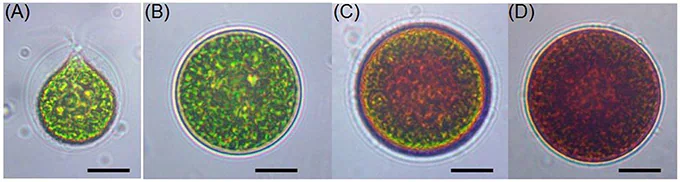
Yeasts and bacteria
The red yeast Xanthophyllomyces dendrorhous (also known as Phaffia rhodozyma) and bacteria such as Paracoccus carotinifaciens also make astaxanthin and are grown commercially.1,12
Up the food chain
Animals cannot make astaxanthin, but they store what they eat. Microalgae are eaten by zooplankton and crustaceans such as krill and shrimp, which are eaten by fish such as salmon and trout.3 Wild sockeye salmon has been reported to carry about 26–38 mg per kilogram of flesh; farmed salmon and trout receive astaxanthin in their feed.1
- Microalgaemake astaxanthin
- Zooplankton, krill and shrimpeat the algae and store the pigment
- Salmon and trouteat crustaceans; the pigment colours their flesh
On fish farms, astaxanthin is added to the feed instead.
Made by nature or made in a factory
Astaxanthin can also be made chemically from petrochemicals. Because synthesis is cheaper, reviews from the 2010s estimated that around 95% of astaxanthin on the market was synthetic, while astaxanthin from H. pluvialis is the main source for supplements, cosmetics and food.2,3 Each source yields a slightly different mixture.
Why is astaxanthin red?
Colour depends on which light a molecule absorbs. Astaxanthin absorbs blue-green light most strongly, at around 470–480 nanometres depending on what it is dissolved in.1,10 We see the light left over, which reads as red-orange.
Surroundings matter too. In a living lobster, astaxanthin is held inside a protein called crustacyanin, which shifts the light it absorbs and makes the shell look slate blue. Cooking breaks the protein apart and the shell turns red. Similar astaxanthin–protein complexes are common in crustaceans.10
H. pluvialis builds up astaxanthin under stresses such as intense light, nitrogen shortage, high salt and heat.1 The red cyst is a survival stage,2 and researchers have found that making astaxanthin is an active response that protects the cell from strong light.13
We explore the chemistry of colour further in Article 02: why is astaxanthin red? (coming soon)
How does astaxanthin work as an antioxidant?
Free radicals and reactive oxygen species
A free radical is a molecule with an unpaired electron, which makes it reactive: it tends to take an electron from a neighbour and can start a chain reaction. Reactive oxygen species (ROS) are reactive oxygen-containing molecules. Some, such as superoxide, are radicals; others, such as hydrogen peroxide, are not.8
ROS are not simply villains
Cells make ROS constantly, for example in the mitochondria that turn food into energy,8 and UV light adds more in the skin.3 At low, controlled levels ROS are useful signals that help cells adapt.8
What oxidative stress means
Oxidative stress is an imbalance in favour of oxidants that can disrupt normal signalling and damage fats, proteins and DNA. The body’s main antioxidant defence is its own enzymes, not small antioxidant compounds from food.7
- Oxidants (reactive oxygen species)
- Defences (mainly the body’s own enzymes)
- Astaxanthin spans the membrane, with an oxygen-bearing end at each surface
- Beta-carotene lies within the fatty core
How astaxanthin acts at a molecular level
Carotenoids neutralise reactive molecules in two main ways: absorbing the excess energy of singlet oxygen and releasing it as heat, and reacting with radicals to stop chain reactions.1 In a laboratory study using model membranes, astaxanthin preserved membrane structure and lowered fat oxidation by about 40%, whereas beta-carotene and lycopene disordered the membrane and increased oxidation.9
Why laboratory results are only the beginning
A test-tube assay measures one reaction under fixed conditions. It cannot show how much the body absorbs, where it goes, or whether skin changes. Claims that astaxanthin is “many times stronger” than vitamin C come from specific assays, and different assays rank antioxidants differently. Attempts to treat disease by broadly mopping up ROS with antioxidant compounds have generally not succeeded.8 Only studies in people can show effects in people.
Why is astaxanthin studied for skin and beauty?
Skin meets UV light and pollution every day, and laboratory and animal studies suggest astaxanthin has antioxidant, anti-inflammatory and UV-protective activity.3 Most human research has tested oral supplements of a few milligrams a day, measuring hydration, elasticity, wrinkles and responses to UV.
A 2021 meta-analysis pooled nine placebo-controlled trials of oral astaxanthin. It found significant improvements in skin moisture and elasticity, but no significant reduction in wrinkle depth. The trials were small and their results varied considerably.4
In one 10-week trial, 23 healthy Japanese adults took 4 mg a day. The astaxanthin group needed a higher UV dose before their skin reddened and lost less moisture in UV-exposed skin than the placebo group.5 The study was funded by the authors’ employer, FUJIFILM, and it does not mean astaxanthin can replace sunscreen.
Applied to skin: much less evidence
The same meta-analysis found only two studies of topical or combined use, both open-label, meaning participants knew what they were using.4 In one, 30 women took and applied astaxanthin for eight weeks, in a study run by an ingredient manufacturer.6 How astaxanthin is distributed in human skin has not been studied comprehensively.3
An ingredient is not a finished product
A study of one ingredient at one dose does not show that a cream, serum or lipstick containing it will do the same. Concentration, the rest of the formula, stability and use all change the outcome, so ingredient research is not evidence for any particular product, including ours.
Where the evidence stands
Are all types of astaxanthin the same?
Free-form or esterified
In nature, astaxanthin is often bound to one or two fatty acids: esterified astaxanthin. Without them it is free-form. In red H. pluvialis cysts, about 70% carries one fatty acid, 25% two and only 5% is free,2 while the yeast X. dendrorhous makes mainly free astaxanthin.12 Some skincare ingredients, such as Asta-S, are described by their developers as free-form.
Mirror-image shapes (stereoisomers)
Astaxanthin has a “handed” carbon atom at each end (positions 3 and 3′). Like gloves, each can be left- or right-handed, giving three versions: 3S,3′S; 3R,3′R; and 3R,3′S. H. pluvialis makes mainly 3S,3′S, X. dendrorhous mainly 3R,3′R, and synthetic astaxanthin is a 1:2:1 mixture of all three.1,12
Free-form or esterified
- Free-formno fatty acid attached; about 5% in H. pluvialis cysts
- Monoesterone fatty acid; about 70%
- Diestertwo fatty acids; about 25%
Mirror-image shapes
- ↺ ↺3S,3′Smainly made by H. pluvialis
- ↻ ↻3R,3′Rmainly made by the yeast X. dendrorhous
- ↻ ↺3R,3′Sthe mixed (“meso”) form
Synthetic astaxanthin contains all three, in a 1:2:1 ratio of 3R,3′R, 3R,3′S and 3S,3′S.
Three separate questions
Source tells you what made the astaxanthin. Form tells you its shape and whether fatty acids are attached. Formulation tells you how much is present and how it is protected from the light, heat and oxygen that can degrade it.12 A label that answers one question does not answer the others. Our full comparison is coming in Article 03: types of astaxanthin compared (coming soon).
How is astaxanthin used today?
- Aquaculture and feed. It colours farmed salmon, trout and shrimp, and is approved in the United States as a colour additive in fish and animal feed.1
- Food supplements. Astaxanthin from H. pluvialis is sold as a supplement in Europe, Japan and the United States.3
- Food research. Scientists are exploring it as a natural colour and functional ingredient, although cost and scarce natural sources limit its use.12
- Cosmetics. It appears in creams and other skincare,1 where protecting it from light, heat and oxygen is part of the formulator’s job.12
- Biotechnology. Growing H. pluvialis and fermenting astaxanthin-producing yeasts and bacteria at scale are active fields.2,12
Researchers are also studying astaxanthin for heart, eye and brain health, mostly in animals or small trials.1 None of these is an established treatment; astaxanthin is not a medicine.
Common myths about astaxanthin
MythAstaxanthin comes only from shrimp.
FactShrimp only accumulate it. Microalgae, yeasts and bacteria make it, and it is also synthesised chemically.1
MythAstaxanthin is a vitamin.
FactIt is a pigment. The body does not depend on it, and it is not converted into vitamin A.1
MythRedder means better quality.
FactColour shows red pigments are present, not which form, how much, how pure or how stable. Other carotenoids, such as canthaxanthin, are red too.2
MythIt is proven to reverse ageing.
FactNo study shows that. Oral trials report modest changes in moisture and elasticity, and pooled wrinkle results were not significant.4
MythEvery astaxanthin ingredient is the same.
FactIngredients differ in source, stereoisomers, esterification, purity and formulation.1,2
Frequently asked questions
Is astaxanthin natural?
It can be either. Microalgae, yeasts and bacteria make natural astaxanthin; synthetic astaxanthin is made chemically and widely used in animal feed. Check the label or ask the brand if the source matters to you.
Which foods contain astaxanthin?
Salmon, trout, shrimp, krill and crayfish, in amounts that vary by species, diet and whether the animal was wild or farmed.
Is astaxanthin safe?
Europe’s food safety authority concluded that up to 8 mg a day from supplements, on top of a normal diet, is safe for adults; for children that amount exceeds the acceptable daily intake.11 If you are pregnant, breastfeeding, taking medication or managing a health condition, ask a doctor or pharmacist first.
Is taking astaxanthin the same as applying it?
No. Oral astaxanthin travels through the blood; topical astaxanthin is applied to the skin. Most skin research has used supplements, and the two routes cannot be assumed to give the same results.
What does “free-form astaxanthin” mean on a label?
Astaxanthin not bound to fatty acids. It describes the molecular form only, not the concentration, the stability of the formula or what the product does.
The bottom line
Astaxanthin is a red carotenoid made by microalgae, yeasts and bacteria, gathered by krill, shrimp and salmon through the food chain, and also synthesised. Its membrane-spanning structure makes it an effective antioxidant in the laboratory.
In people the evidence is promising but modest: small oral trials suggest benefits for skin moisture and elasticity, while topical research is at an early stage. No ingredient study can stand in for evidence about a specific product.
Understanding an ingredient is more useful than following a trend: it helps you read labels and choose for the right reasons. Continue with why we started with astaxanthin or the ingredient library.
This article is for general education. It is not medical advice, and it does not describe the effects of any ASTAMALL product.
References
- Ambati RR, Phang SM, Ravi S, Aswathanarayana RG (2014). Astaxanthin: sources, extraction, stability, biological activities and its commercial applications—a review. Marine Drugs, 12(1):128–152. doi:10.3390/md12010128 PubMed 24402174
- Shah MMR, Liang Y, Cheng JJ, Daroch M (2016). Astaxanthin-producing green microalga Haematococcus pluvialis: from single cell to high value commercial products. Frontiers in Plant Science, 7:531. doi:10.3389/fpls.2016.00531 PubMed 27200009
- Davinelli S, Nielsen ME, Scapagnini G (2018). Astaxanthin in skin health, repair, and disease: a comprehensive review. Nutrients, 10(4):522. doi:10.3390/nu10040522 PubMed 29690549
- Zhou X, Cao Q, Orfila C, Zhao J, Zhang L (2021). Systematic review and meta-analysis on the effects of astaxanthin on human skin ageing. Nutrients, 13(9):2917. doi:10.3390/nu13092917 PubMed 34578794
- Ito N, Seki S, Ueda F (2018). The protective role of astaxanthin for UV-induced skin deterioration in healthy people—a randomized, double-blind, placebo-controlled trial. Nutrients, 10(7):817. doi:10.3390/nu10070817 PubMed 29941810 Funded by FUJIFILM Corporation, the authors’ employer.
- Tominaga K, Hongo N, Karato M, Yamashita E (2012). Cosmetic benefits of astaxanthin on human subjects. Acta Biochimica Polonica, 59(1):43–47. PubMed 22428137 Authors affiliated with Fuji Chemical Industry, an astaxanthin producer.
- Sies H (2015). Oxidative stress: a concept in redox biology and medicine. Redox Biology, 4:180–183. doi:10.1016/j.redox.2015.01.002 PubMed 25588755
- Sies H, Jones DP (2020). Reactive oxygen species (ROS) as pleiotropic physiological signalling agents. Nature Reviews Molecular Cell Biology, 21(7):363–383. doi:10.1038/s41580-020-0230-3 PubMed 32231263
- McNulty HP, Byun J, Lockwood SF, Jacob RF, Mason RP (2007). Differential effects of carotenoids on lipid peroxidation due to membrane interactions: X-ray diffraction analysis. Biochimica et Biophysica Acta – Biomembranes, 1768(1):167–174. doi:10.1016/j.bbamem.2006.09.010 PubMed 17070769
- Cianci M, Rizkallah PJ, Olczak A, et al. (2002). The molecular basis of the coloration mechanism in lobster shell: β-crustacyanin at 3.2-Å resolution. Proceedings of the National Academy of Sciences of the USA, 99(15):9795–9800. doi:10.1073/pnas.152088999 PubMed 12119396
- EFSA Panel on Nutrition, Novel Foods and Food Allergens (NDA), Turck D, et al. (2020). Safety of astaxanthin for its use as a novel food in food supplements. EFSA Journal, 18(2):e05993. doi:10.2903/j.efsa.2020.5993 PubMed 32874213
- Stachowiak B, Szulc P (2021). Astaxanthin for the food industry. Molecules, 26(9):2666. doi:10.3390/molecules26092666 PubMed 34063189
- Wang B, Zarka A, Trebst A, Boussiba S (2003). Astaxanthin accumulation in Haematococcus pluvialis (Chlorophyceae) as an active photoprotective process under high irradiance. Journal of Phycology, 39(6):1116–1124. doi:10.1111/j.0022-3646.2003.03-043.x